How Cool is Vanilla Ice?
Surprises about Vanilla Ice's music and his life are revealed in two never-heard 1990s interviews with the "Ice Ice Baby" rapper
Vanilla Ice was – and still is – a big deal. And, chances are, you don't know the real story.
Thirty-six years after his song "Ice Ice Baby" became the very first rap to reach #1 on the Billboard singles chart, it remains a massive hit on Spotify. And, partly because of his controversial role in Trump's Freedom 250 concert (and the revival of his song, both by Olympic hockey fans and MAGA supporters of ICE), Vanilla Ice continues to make news.
When Robert Van Winkle aka Vanilla Ice went from debt-ridden Texas rapper to instant world-wide fame with his 1990 album To The Extreme, PEOPLE magazine had to get involved. So I met him for an interview on the 45th floor of a Manhattan hotel. He famously pulled down his pants to show me his scars from a knife fight, a detail that Jim Carrey later lampooned in his "White White Baby" parody on In Living Color.
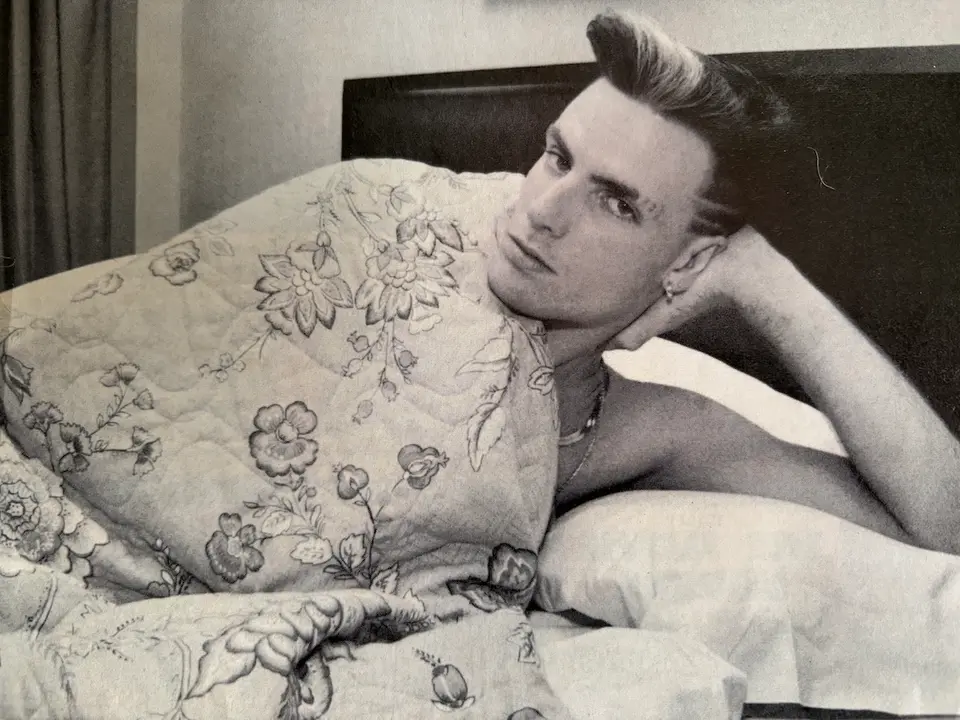
Acey Harper, one of the great PEOPLE photographers, caught Ice in bed for the lead image in my article.
You can hear Vanilla Ice discuss his life and career in excerpts from my 1990 and 1993 interview tapes, which I saved all these years and share for the first time in this episode of I Couldn't Throw It Out. As it turns out, Vanilla Ice's rap skills were more advanced than I remembered, and his life story (including complicated relationships with his parents) was emotional and complex. Later in life, he showed admirable versatility as he faced obstacles in his music career, creating "The Vanilla Ice Project," a TV show in which he renovated and flipped houses for nine seasons.
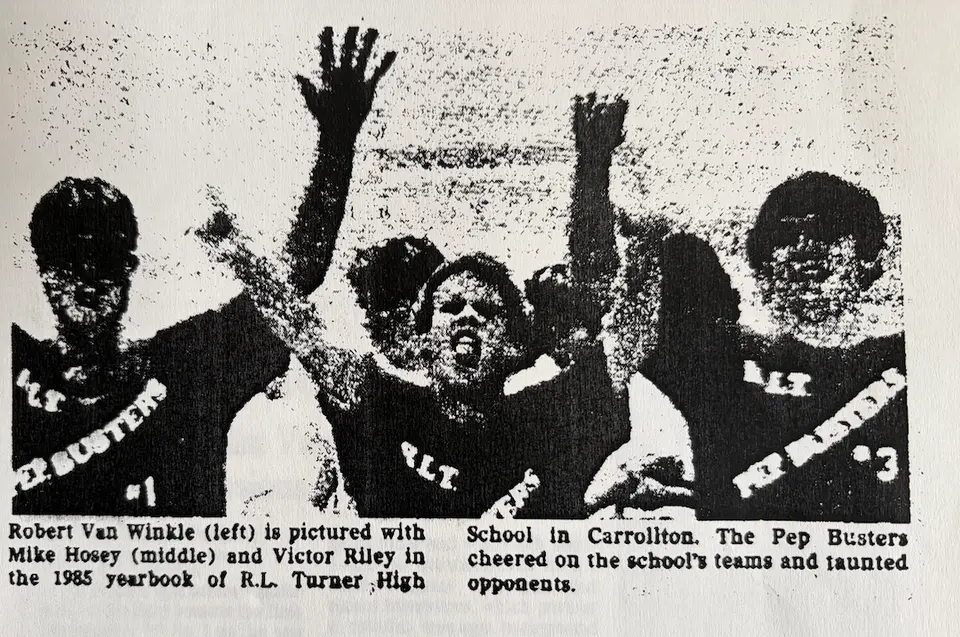
I saved this grainy photo from The Dallas Morning News, of the future Vanilla Ice, cheering with his high school Pep Busters.
Music writer David Browne, the author of many music biographies and a contributing writer to Rolling Stone, is – yes, it's true -- quoted on the Vanilla Ice Wikipedia page. So I'm very lucky that he joined me to assess Ice's legacy and to help me decide what to do with everything I saved from my Ice escapades.
And now, for your viewing pleasure...
In case you never saw the origina video for "Ice Ice Baby," it's not too late...
Of course, you'll want to watch Jim Carry's "White White Baby" parody from In Living Color.
For background on rap mogul Suge Knight's claim that his client Mario "Chocolate" Johnson was a writer of "Ice Ice Baby," you can hear what Mario has to say.
Here's Vanilla Ice talking with Newsmax about the Freedom 250 concert and ICE-supporters using his song:
And here he is on Fox:
And, just to be complete, here he is on TMZ:
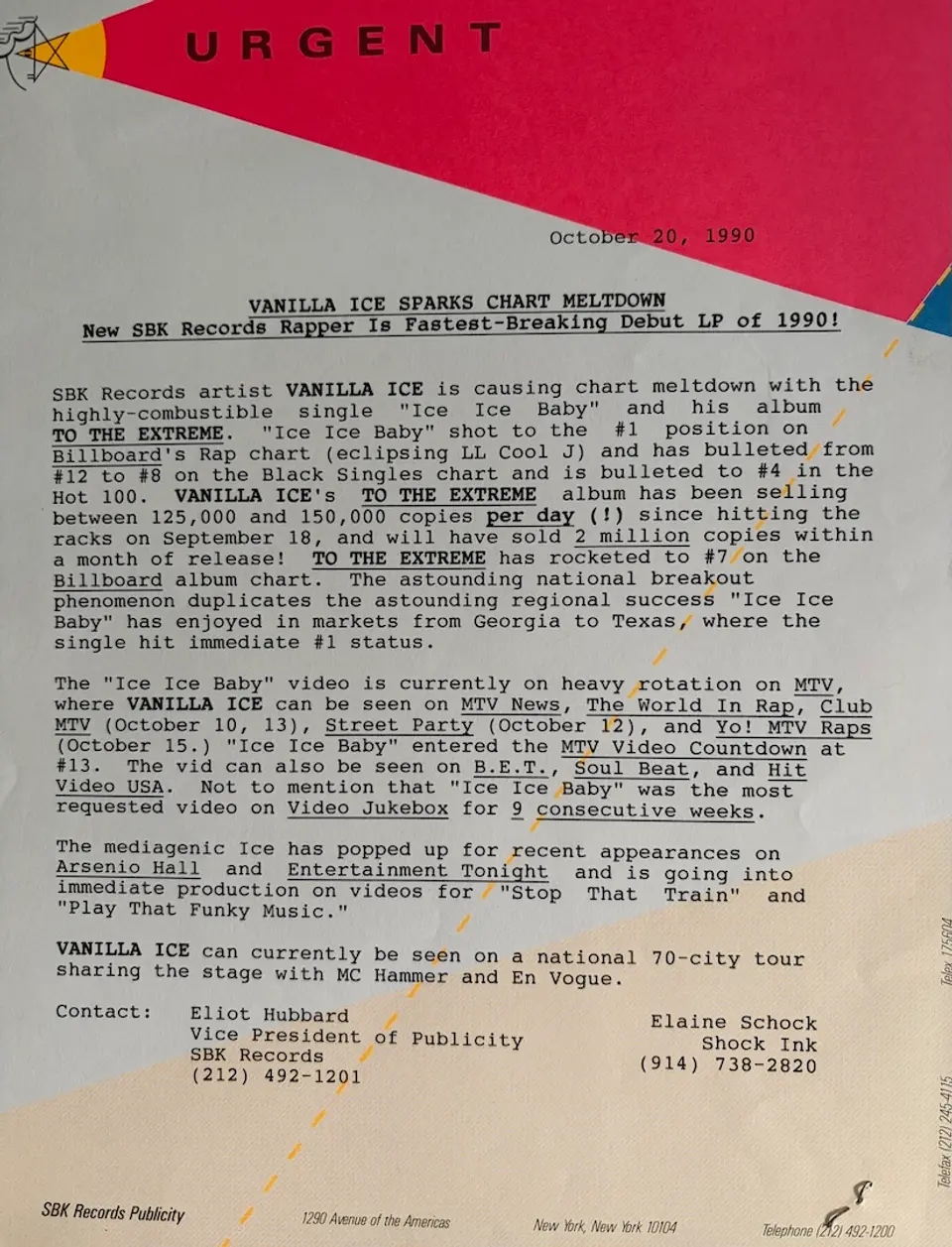
And in case you'd like to see what I can't quite throw out... how about this 36-year-old press release from SBK Records:
And my tapes:
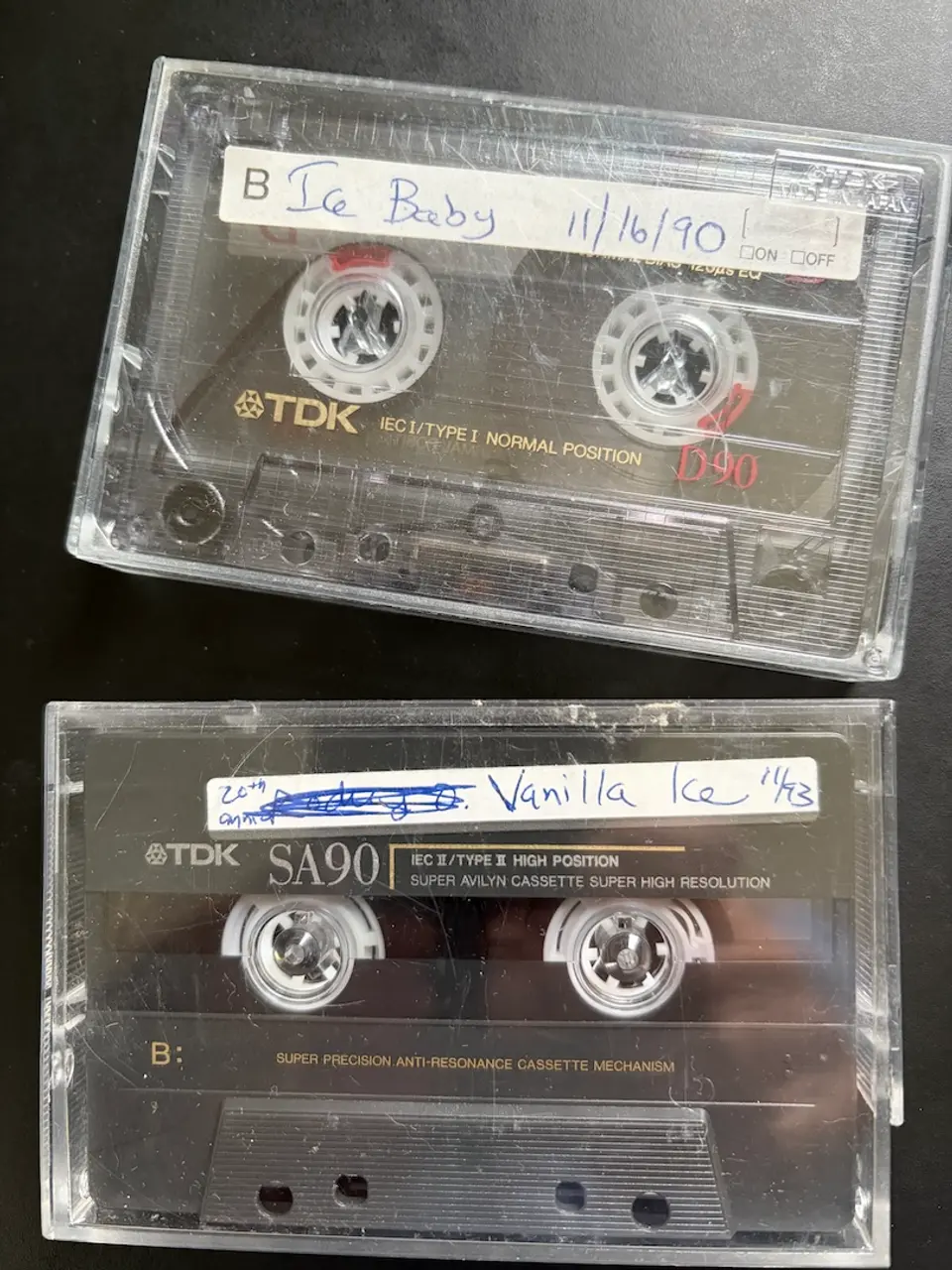
Coming soon: A playlist of the Vanilla Ice songs you missed -- and some you might want to rediscover.
Have thoughts about this episode? Send us a text
More info, photos, and transcript: throwitoutpodcast.com
Don't miss a thing: Join our mailing list
Do you save stuff you can't throw out? Tell us about it
Want to show support? Please rate/follow us wherever you get your podcasts.
01:22:44 - 6 - Introduction
09:06:25 - 2 - "Ice Ice Baby" and Queen/David Bowie's "Under Pressure"
13:08:25 - 9 - Vanilla Ice - not political
17:49:34 - 6 - Rap and race: Being a white rapper
21:25:13 - 6 - Did good looks help Vanilla Ice?
23:10:28 - 4 - Vanilla Ice discusses fame
26:09:58 - 2 - Struggling before fame
26:43:54 - Early years on the streets
30:12:22 - Getting stabbed
33:13:05 - 4 - Mixed feelings about guns
36:36:32 - 2 - Angry album never released
44:28:17 - 6 - Why Vanilla Ice hid his past
52:13:34 - 4 - Complicated parent relationships
56:43:12 - 6 - Vanilla Ice: "Why am I different?"
59:04:21 - Vanilla Ice and Trump
I Couldn't Throw It Out, Season 3, Episode 42
How Cool Is Vanilla Ice?
Surprises about his music and his life are revealed in two never-heard 1990s interviews with the "Ice Ice Baby" rapper
Michael Small (00:00.118)
On this episode of I Couldn't Throw It Out, I share my interview from 36 years ago with a young man who changed pop culture. He recorded the first rap single to hit number one on the Billboard charts. The song was Ice Ice Baby, and the performer was known as Vanilla Ice. Over the years, some critics wrote him off as a lightweight, but listening now to his words when he was 23,and considering his involvement this summer with Trump's July 4th concert, his life story is much more interesting than many of us realized.
[Interview excerpt starts]
Vanilla Ice (00:38.314)
I've never met anybody in this world like me. I don't know what it is. I sit back in in my bed sometimes and think, Why am I Vanilla Ice? Why am not somebody else you know? I mean, why am I so different? Why? Why did I get into rap? Why why didn't I follow like everybody else? Why didn't I go to college and and become a lawyer or something, you know?
[Interview excerpt ends]
Michael Small (00:58.84)
To hear more from Vanilla Ice and find out what happened after his big hit song, keep listening.
[Song excerpt begins]
I couldn't throw it out
I had to scream and shout
Before I turned to dust I've got to throw it out
[Song excerpt ends]
Michael Small(01:22.446)
Hello and welcome to I Couldn't Throw It Out. My name is Michael Small, and like many of you, I am guilty of saving things. Lots of things. And on this podcast, with my guests, who are also savers, we try to decide what to do with our stuff before somebody else throws it out. Today, we're sorting through everything I saved from my encounters with the first famous white rapper. He was born with the name Robert Van Winkle, but you probably know him as
Vanilla Ice. Back in 1990, I interviewed Vanilla Ice for People magazine. We met on the 45th floor of a hotel in Manhattan. And yes, I am the hard-hitting reporter who inspired Vanilla Ice to pull down his pants and show me a little scar on his butt. Now I know you're fascinated, so we'll have more details later. At the time, Vanilla Ice's trademark single Ice Ice Baby was the very first rap song to hit number one of on the Billboard Hot 100 singles chart. Meanwhile, his first album sold 15 million copies worldwide. And to give you an idea, that's about the same as the debut albums by Mariah Carey and Van Halen. Vanilla Ice was so famous that he even dated Madonna till he decided to break up with her. Or at least that's how he explained it. I started thinking about Vanilla Ice again this summer when he made headlines for Trump's July 4th concert. When it clearly was becoming a political rally, every major performer dropped out except Vanilla Ice. The concert was canceled at the last minute, supposedly because of dangerous weather, which didn't actually arrive, or maybe Trump had second thoughts and decided that vanilla was not his favorite flavor of ice. When I met Vanilla Ice, I was skeptical. I had read the vicious reviews of his music and the interviews where half of what he said did not seem to be true. But as I listened to my tapes thirty-six years later, I started to think I didn't give him a chance. It made me wonder, was Vanilla Ice a phony? Or was he an innocent twenty-three year old who got flipped upside down by fame? And his music, was it as bad as the critics said, or was it kind of fun and danceable? And then there's the rest of his life. Did he turn into a reality TV clown by appearing on shows like The Surreal Life? And did he go full-on MAGA? Or is he just a nice guy who wants to be friends with everyone, including our president? Turns out that those questions are more complicated than I expected, so I've lured in a celebrity to help me with the answers. He is the esteemed music writer and critic, David Browne. David and I met when we both worked at Entertainment Weekly magazine, where he wrote about music. He's now a contributing writer at Rolling Stone, and he's the author of several excellent pop music biographies about Jeff and Tim Buckley, Crosby Stills and Nash, Sonic Youth, and The Grateful Dead. And as if that's not enough, David recently published Talkin' Greenwich Village, a history of the music scene in that famous New York neighborhood. The New York Times raved that this book is "impeccably researched, elegantly written, and consistently fascinating." David also writes The DBrief, a very entertaining Substack about pop music. But most astonishing of all, David's 1991 review of Vanilla Ice's Extremely Live album is quoted for posterity on the Vanilla Ice Wikipedia page. David, we bow to you. And we welcome you.
David Browne
Thanks, Michael. It's great being here. And yes, I think that is the crowning moment of my career. Having my less than rave review of one of the silliest live albums of all time being included on the Wikipedia page. Pretty funny.
Michael Small
Was this a surprise when you went to the Vanilla Ice page?
David Browne
I did remember in the back of my brain reviewing that album, which is now thirty five years ago. Is that correct?
Michael Small
Yeah.
David Browne
It was actually a very pivotal moment in his career 'cause it was such a massive mistake. He had just come off, as you mentioned, To The Extreme, which was this huge record, polarizing for sure, but very successful, and he was not just one of the biggest white rappers, biggest rappers at the time, but to follow it up a year later with a live album which had a couple of new songs on it, but it's not your typical sequel to a huge record and and the one moment that I remember is that he had dancers on stage and he would have a moment in the show where they would just be dancing together with minimal rhythm track behind them. And I'm sure if you were in the audience and watching that and you were a teenager in the early nineties too maybe it was kind of cool and exciting. But to hear that on the record you know, like all of a sudden you're listening to this record and all you're hearing are stomping feet for five minutes or something. And I just thought this is the most insane thing I've ever heard on a record.
Michael Small
It's interesting that Vanilla Ice released five more studio albums and he didn't have a big hit on any of them. But Ice Ice Baby has lasted in a very surprising way. It has been streamed something like half a billion times on Spotify.
David Browne
Wow.
Michael Small
And Spotify did not exist until 20 years after the song was released. It seemed to have a huge resurgence related to the Winter Olympics when people started using it on TikTok videos. But also a more negative side to it is that MAGA fans used it in an ugly way to badger anti-ICE protesters. It's very much a mixed legacy here. But do you have anything to say about why this song had such staying power? Is it at all related to the music?
David Browne
I think the song staying power probably has to do with a couple of things. And one of them is nostalgia, especially like Gen X nostalgia. There's a lot of nineties nostalgia in the air right now. Look at that JFK Jr. TV show. In some way, Vanilla Ice, who became a huge star at the very beginning of that decade, is getting a little bit swept up in that. But also, Ice Ice Baby is a really well made record.
Michael Small
I think we gotta jump right into one of the biggest controversies about the song. But first, I want to remind anyone who does not remember that hip hop records often use what is called sampling. This means they take beats from other people's songs and they alter them for a new song. In this case, Vanilla Ice's team took the beat from Under Pressure, the nineteen eighty-one song by Queen and David Bowie.
David Browne
There were a lot of people when that record came out who thought it wasn't a worthy record to have sampled Under Pressure. But I think there are other people who think actually Ice Ice Baby and his incorporation of a sample from that song is a better record than the Queen David Bowie collaboration in terms of just being a a sharper, punchier, you know, more danceable piece of music. And I kind of see that.
Michael Small
Well, we happen to have a couple little samples here for anybody who doesn't remember what we're talking about. This one is from Under Pressure, so you can hear what they did. Listen to this.
[Short music sample from Under Pressure]
Michael Small (09:06.252)
Okay, and now here's what they did with it for Ice Ice Baby.
[Short music sample from Ice Ice Baby]
David Browne (09:17.504)
It's pretty close, but they picked up the beat more and it's a little more layered. It was interesting early days of sampling. Sampling was still kind of a new art. It was a little bit of the wild, wild west in terms of getting rights to things. There was a lot of skepticism back then about records that were made based on samples, as if that wasn't valid music. Was he kind of damaging this great piece of music by Queen and David Bowie? I think in retrospect, Ice Ice Baby actually, despite everything, holds up as a pretty, pretty snappy little record.
Michael Small
I'm so glad you said that because I feel like it's easy to take cheap shots at Vanilla Ice, which a lot of people did over the years. And though there are legitimate criticisms people could make, I really appreciate the fact that you were open enough to take in the song and say that it has value. I did ask Vanilla Ice about that, and I'll play you what he told me.
[Interview excerpt begins]
Michael Small
With Ice Ice Baby, did David Bowie's people get in touch with you and ask you to put the name back on 'cause I noticed it appeared in Billboard.
Vanilla Ice
Yeah, sample by David Bowie and Queen. Wow. It's not Under Pressure. You can't even play one record and mix the other one in with it because it's totally different. That is not what made that song a hit. Different beat the lyric and me, I made the song.
[Interview excerpt ends]
David Browne (10:43.054)
He has a point. He wrote an original rap over it. I think it's about like a drive-by shooting or something. He did bring something to it.
Michael Small
Do you remember what happened when Queen and David Bowie threatened to have a lawsuit?
David Browne
I don't remember those details, Michael. So please fill me in.
Michael Small
They they settled out of court for an undisclosed sum and then he had to give them writer credits, as he said. He later bought the publishing rights for Under Pressure, because he said it was more cost effective than paying for the rights whenever the song was played.
David Browne
Wow.
Michael Small
Now I want to ask you to think for a minute and can you think of another famous run-in with someone who claimed rights to that song?
David Browne
Was that the Suge Knight incident?
Michael Small
You got it. Yeah. I knew you would remember. I knew it, yes. We might need to identify that Suge Knight, who is now in prison for voluntary manslaughter, was a business partner of Dr. Dre.
David Browne
Yes. A big intimidating kind guy in the music business. Like physically and in every other way. And I think the story was that he like literally shook down Vanilla Ice for the rights to Ice Ice Baby. Like he wanted Vanilla Ice to sign the rights away.
Michael Small
He actually had a client, he said, named Mario Chocolate Johnson, who claimed that he helped write Ice Ice Baby and had to be paid a lump sum. And what's interesting is that Suge used his share to start Death Row Records. That label later released albums by Tupac and Snoop Dogg. So it turns out that Vanilla Ice may have contributed to rap history in ways that no one expected.
David Browne
He contributed to rap history in so many ways, Michael.
Michael Small
It's yeah. And you know, I was skeptical about Suge's claim, but there's a pretty convincing YouTube clip of Mario talking about his work with Vanilla Ice. I'll share it in the show notes for anyone who's curious about this. So you can come to throwitoutpodcast.com and see that clip and other ones. Anyway, we talked about the music rights, but what about Vanilla Ice as a rapper? When I asked him what made him special, here is what he told me.
[Interview excerpt begins]
Vanilla Ice
It's like my own style, I call it the Ice style. It like sticks in your head. You know, the rap, you can understand it. It's not like something going, I wanna rock wanna run with me and then people be like, you know, what did he say? Mine's more like, All right, stop. Collaborate and listen. ICE is back with my brand new invention. You know, you can understand every word but it's real
Michael Small (13:07.859)
But somebody was saying like they said, Rap is not about Ice Ice Baby, it's about fight the power.
Vanilla Ice (13:13.922)
That's for the political people. I love Chuck D and them because they're just fighting for what they believe in, you know. And they're political. Because, you know, rap like I said, rap music is about expression and you know, they that's the way they want to express themselves. That's what goes through their heads. That's not what goes through my head. You know what I'm saying? I'm not thinking day in, day out, all the political stuff. I'm more of a party freak, you know. You know, I'm with the girls and stuff. I'm not with all this this political Mandela stuff and all this stuff, you know. I mean, I understand it all and I and I and I can relate to it all, but what goes through my head is stories. I think of stories. You could write a movie on each one of my songs. They tell a story, you listen to the the song and you listen to the whole thing all the way to the end to find out what happened at the end of the story. It's a trip, you know.
[Interview excerpt ends]
David Browne (13:59.842)
Yeah, you listen to that clip now and you see the seeds of his demise being planted right there in several ways. First of all, there's the line about that Mandela stuff. I'm not interested in that stuff. Yeah. And then the reference to a movie, even though you know, he's only talking about the idea and concept that his songs are like movies, because he was in two movies at that time that right after at the peak of his success, that pretty much put that nail in the coffin.
Michael Small
One was Cool as Ice, in which he plays a motorcycle riding rapper. Did you ever see it?
David Browne
I saw it only a couple of years ago, or maybe maybe ten years ago, which was many years after it come out. It just happened to be on cable.
Michael Small
Is it a camp classic?
David Browne
That that's probably a nice way of putting it. It was interesting seeing him as the wrong side of the tracks, bad boy. He has a a a thing for this girl, but she's with like the preppy kind of guy. And the only line I remember is when he makes the case to the girl whether she should ditch the boyfriend for him, he says, Get with the hero, not the zero.
Michael Small
Yeah. That's a famous lie.
David Browne
And you look at all the missteps that he made when you look back on it. Did he have some skill as a rapper, as he said? Yeah. Can he enunciate the words more clearly than some other rappers, I guess. And I guess that was part of his appeal. But the way in which he and his team followed up that success, it's like a case study in exploiting a career without any real long term vision. You know, first you threw out this live album that had a really bad version, I remember, of Satisfaction, the Rolling Stones song. It was like a rap version of Satisfaction, which was terrible. And then he's in the Teenage Mutant Ninja Turtles movie.
Michael Small
It was a concert scene.
David Browne
If you want to be taken seriously as a hip hop artist, that wasn't really the way to go at the time. It seemed like you were aiming for like little kids. It's a very confused message. And you know, this is a period of time in the early nineties when hip hop was getting like more visceral and more political. So to have some guy come out and say, Well, I don't want anything, I just wanna sing about girls and parties was kind of very uncool.
Michael Small
But there's another thing we haven't discussed, which is his race, because a lot of longtime rap fans were not happy that the first rap song to go to number one was by a white guy. And here's an interesting twist. When I was doing interviews for my book about rap music, I asked several major rappers about Vanilla Ice. The black rappers I asked were not bothered by him. Like Eric B., Too Short, Public Enemy. They weren't like "He's stealing our art form" or "he's degrading our art form" or anything like that. Whereas the white rappers like Third Bass could not stand him.
David Browne
Right. They had a song attacking him, right? There was a Third Bass song, Pop Goes the Weasel. To his credit, Vanilla Ice did come out of a Texas hip hop scene and he was part of a a crew where he was like, I believe the only white member of this sort of hip hop performing crew. The VIP posse or whatever they called it. He had roots in an actual hip hop scene, you could argue that he helped make the music bigger in the culture.
Michael Small
Yes.
David Browne
By nineteen ninety rap was pretty big, but to have a a hip hop song be number one might have in some ways helped a lot of the rappers because it just made it. It legitimized it. There were a few big rap songs before that, but nothing quite like that at all. Vanilla Ice really it took it to suburbs in an even bigger way than it had before and I think probably some rappers thought that was really helpful.
Michael Small
I asked Vanilla Ice whether it was easier or harder to be a white rapper and I'll play you what he said.
[Interview excerpt begins]
Michael Small
Is it harder or easier to be white and be a rapper?
Vanilla Ice (17:49.346)
Harder. You gotta get accepted. Rap music is still black due to the fact that rap music came from the streets. That's why you don't see many white guys in rap music, because there's not too many white guys from the street. And I happen to be one that is from the streets. I grew up in a lower middle class area about a block away from the projects, called the ghettos. Now we all went to the same school, rapped at house parties, but it's just my way of life. And there's not too many white kids to grow up that way. But as far as, you know, rap music, as far as it making a difference the color. It shouldn't matter if you're black, white, Puerto Rican or Jew. As long as you can rap and do what you do.
Michael Small (18:25.326)
Yeah. Some people are gonna say it's only a white guy's gonna get that kind of success.
Vanilla Ice(18:31.714)
Well that's not true because the album when it first came out was on a black label. I mean the whole front of it we rushed it out so fast it didn't have any picture of me or anything and everybody thought I was black. Music went number one before anybody knew what color I was. Then the video came out. When the video came out it's like it moved over to the pop chart.
Michael Small (18:49.73)
You were saying like one of the things you didn't like in the bio was like they called you the Elvis of Rap. God, I think that was a huge compliment.
Vanilla Ice (18:55.918)
Really? I don't even know really anything about Elvis, okay? Yeah. All I know is he had a lot of hits. He was a star and everything. He's real big. I liked some of his stuff, but I hear he was like from lyrics from Public Enemy, I hear one song that goes, Elvis was a hero to most, was a big biggest racist. That's what they say. He says Elvis is a racist. So if he's a racist then he sure ain't nothing like me because I am not a racist. As a matter of fact, I have one friend in this world that is white. Every other friend I have is black, man. And I see the problems that they go through as far as racism goes and stuff like that. And when people mention the word N-- around me say it offends me. And why should it offend me? I'm white. But when I'm gonna get around some other white people and they think, well, you know, he's just like us, he's white, they can mention the word as long as a black guy's not around, you know. But I get offended by it, man. I really do. I mean like why you gotta call him a N-- you know, unless you're a racist. I don't like racist people. I don't like white people that are racist against black people. I don't like black people that are racist against black people. I don't like racism, period. Because I grew up with them and they're and they're black Americans, just like I'm a white American. Who gives a shit about the color of the skin?
[Interview excerpt ends]
David Browne (20:17.208)
Same guy who ended up at Mar-a-Lago and doing all kinds of other things.
Michael Small
We're gonna get to that in a minute. This is why I feel like at heart Vanilla Ice has some good instincts. He probably doesn't even see the contradiction with the things he's doing now.
David Browne
Yeah, no, it's really interesting to hear him say all that now. And it it also makes you think what a kind of a lost opportunity there was there in his career, because it seemed like everything he did after those first couple of years, like we were just talking about, was aimed at more of a white audience. That movie, his co-stars were white. I mean, it's like he was almost abandoning where he came from in order to keep building on that success. It might be a stretch to say Vanilla Ice sold out, but they did sort of abandon his roots. That might be another factor in his kind of collapse.
Michael Small
I wanna move on to another thing that I think contributed to his fame. If you remember in nineteen ninety, he had this very strange mousssed up hair, kind of like a robot hairdo, but underneath his hairdo, I think there's no question he was a good looking guy. So I asked him if he thought his looks affected his fame, and here's what he said.
[Interview excerpt begins]
Vanilla Ice (21:24.736)
Image is a definite factor. Very important. In album sales and everything. Why would anybody wear a suit? If image wasn't important, everybody run around naked. Yeah.
[Interview excerpt ends]
David Browne (21:33.614)
Well, I think he's right. One of the striking things about Vanilla Ice when he kind of burst on the scene, you know, with Ice Ice Baby is that he was a good looking guy. He had these sort of chiseled features. He was more conventionally handsome than the Beastie Boys or the guys in Third Bass, you know. Not to slag their art, but I mean he did have a look that in retrospect is it's not surprising that they decided to put him in a movie. As far as Elvis, I mean I think that the line about him probably back then was more that he was more like Pat Boone than Elvis. You know, he was like, you know, a white guy kind of culturally appropriating hip-hop the way, you know, Pat Boone did when he would do remakes, his own versions of like Little Richard songs and have bigger hits than those guys did.
Michael Small
If we're gonna talk about running around naked the way he did when he was twenty four and Madonna was thirty-three, that's when they were an item. He claimed that she proposed to him, though he may not be the most reliable source on that. But it does seem that he broke up with her, as I mentioned earlier. Do you know the reason?
David Browne
I don't know, Michael. Please.
Michael Small
She put erotic photos of them in her nineteen ninety two coffee table book called Sex. And supposedly she never asked for his permission.
David Browne
Wow. Did she ever confirm this?
Michael Small
This is coming from him.
David Browne
In other words, she sampled him without permission.
Michael Small
And he should have filed a suit for the rights.
David Browne
Exactly.
Michael Small
At the same time he did not exactly run from fame, he actually loved it. And I thought it was nice to hear how honest he was about that. But listen to what he said to me.
[Interview excerpt begins]
Michael Small
Did you want to be famous?
Vanilla Ice (23:09.884)
Yeah, of course. I've always dreamed about it. It's a dream come true. That's all I can say. It's like I'm just a normal kid, I'm not God, you know, I'm not anybody special just because this is happening to me. It could happen to anybody, you know. I was in the right place at the right time and it's just a dream come true.
Michael Small (23:28.248)
Mm. Did somebody s ever say anything or do anything in regard to your career that just made you feel great? Like is it the girl screaming in the audience?
Vanilla Ice (23:35.822)
That makes me real great 'cause first time I saw a girl faint, you know, I thought, you know, yeah, they'll faint over Michael Jackson or something. Vanilla Ice, you know, I never saw it, never thought it would happen. I was on stage and I got chills through my spine. This girl actually fainted, she was balling, her tears were coming out of her eyes. And every time I look at her, I go, When I was rapping on stage, you know it sends chills through my spine. It was like, God, this is amazing. How could I have this effect on a girl? Another girl fainted in an elevator and she said it and I thought she was joking. She goes... Okay, I was like up against this wall, right? Yeah in the elevator. My three security guards are right around me. Yeah and she gets in the elevator and she doesn't even see me at first. And she gets in, she looks over and she goes Just like that and she's looking at me and you know, we all kinda laugh, you And she goes, my God, I'm gonna faint And they're like, my God, I'm gonna faint And we go, you know, chill out, you know, and we go like this. And the chick fainted. She really did. She goes, and she just fell. My security guards grabbed her and we were going, Holy cow, we were waving in her face, you know, air and stuff. We gave her an autograph, gave her t shirts, gave her everything.
[Interview excerpt ends]
David Browne (24:49.048)
For someone like him to say, Yeah, I wanna be famous and I want the girls and all that kind of stuff, was he was probably being pretty honest.
Michael Small
Yeah.
David Browne
But at the time that was at least, you know, in rock circles and maybe in some hip hop circles, considered outmoded or not a worthy goal that they were somehow co opting your art and you weren't reaching the right people. So, you know, here's Vanilla Ice saying, Now bring it on. You know, I want everybody. It was unusual. I'm not saying it contributed to his downfall, but it was another maybe aspect that made him seem uncool.
Michael Small
But you also had to remember where he was coming from because it's sort of related. In nineteen eighty seven, he was mostly known for his dancing at this Dallas nightclub called City Lights. Then the club's owner, Tommy Quan, gave Vanilla Ice a chance to try rapping. The crowd liked it, so he kept doing it. Quan became his manager and interestingly, Quan is still his manager today. All these years later, that tells you about loyalty. Another positive quality, I think. But anyway, his career did not take off right away. Just a few months before he was famous all around the world, he had major money problems. Here's what he told me about the years before he signed with SBK Records.
[Interview excerpt begins]
Michael Small
Did you ever get into debt or anything?
Vanilla Ice (26:09.582)
Big time. My car, I was having to hide it. They were trying to get it repossessed that I was behind five payments. It was incredible, man. we kept telling the bank, you know, hey man, you know, we're gonna have you the money. We kept coming up with excuses and excuses, but nothing came through. And when they told us about SBK, man, I was like, Yeah, right. I'll believe it when I see it. Because everything kept just teasing me. I was exactly that way. Really. I will believe it when I get the money and the contract in my hand. That's exactly how how bad it was. And sure enough I got it.
[Interview excerpt ends]
Michael Small (26:43.54)
One of the things that that sort of hints at is that he was constantly trying to indicate that he did not come from wealth and that he was a legit rapper because he came from the streets. The only problem with that is that what he said didn't check out. So it was my job as a People magazine reporter to find out what was true. And I asked him about his past only like fifty times, maybe sixty or a hundred times. And I don't know why he didn't toss me right out that forty fifth floor window. It's really interesting to hear how he talked about coming from the streets, so I'll share this with you.
[Interview excerpt begins]
Vanilla Ice (27:21.89)
Been rapping since the seventh grade. In the streets.
Michael Small (27:23.722)
And I'll have to take it on that. I wish you'd give me the more details so I could have proof so I could say to people, believe it.
Vanilla Ice (27:31.746)
What do you wanna know to to to make you believe it? Why would I say I'm from the streets if if I'm not? 'Cause I damn sure am not proud of it.
Michael Small
I can think of a reason actually. Because then rappers are gonna take you more seriously.
Vanilla Ice (27:43.352)
They take me seriously about my lyrics. Like I said, I'll bust anybody out no matter where you're from or something.
Michael Small (27:47.574)
If you listen to what you said before, you said you got gotta be from the street.
Vanilla Ice (27:51.035)
Rap music is from the streets where I learned to rap. I don't give anybody that's not from the streets credit either.
Michael Small (27:56.846)
Seems like your family sometimes settled in these white places and you went and got out of there and went and made black friends somewhere else. Is that right?
Vanilla Ice (28:05.814)
Right? Not really. It was just the neighborhoods were not white neighborhoods. They were just they're mixed. Real mixed. Cubans, blacks, whites. There's no predominantly nothing. But the area that I hung out in was projects. It's the way I grew up. I loved it. I got into it. Have you ever got into anything? I got into it. I like the people. I loved the bass. Go through the hood just bassing and everybody going, Yo man, check out this car, you know, and all the all my homies coming around and stuff, checking out my system. I pop the trunk up, have the bass booming and everybody, Whoa, this shit is dope, man. I hang out, rap with them, rap my ass off with them. That's where I learn to rap. The projects. That's where I learn to rap. I rap
all day yo man check these rhymes out I wrote this one last night you know I'm Sparkling I'm like a towering inferno you wanna learn my song yo it's not a journal you know it's bad man beatboxing how can a white guy just beatbox? You can't do it.
Michael Small (29:04.568)
I know I couldn't.
Vanilla Ice (29:14.97)
[Demonstrates beat boxing] You know how I can we just do that? You know, you can't. Unless you hang around some people from the ghetto.
Michael Small(29:30.104)
So you're in gangs in Florida. You're fifteen or sixteen, you moved to Carrollton, right? You don't know anybody there. It's a middle class suburb. How the hell do you find gangs there?
Vanilla Ice (29:41.238)
Ooh, you better go to Dallas. It's huge, man. No, there's a place called Forest Lane where everybody hangs out. There's big time gangs in there.
Michael Small
So you found Forest Lane on your own and you've met up with people who started hanging out.
Vanilla Ice (29:57.29)
It's you hugest cruise street.
Michael Small (30:00.662)
And you had a stereo system like you wouldn't believe in it.
Vanilla Ice(30:03.37)
Fifteen inch woofers two thousand watts. Shattered the back out back window out, had get plexi glass put in.
[Interview excerpt ends]
Michael Small(30:11.82)
Well, do you buy that?
David Browne
Yeah, I don't know.
Michael Small
Well, I'll gonna give you a little more. He talked about an incident when he was stabbed. When I pushed him to prove it, that's when he pulled down his pants and showed me a small scar in his butt. This moment will live in history because when Jim Carrey did a Vanilla Ice parody on In Living Color, he rapped these words, "I told the world I was stabbed in the butt, but it was a toilet paper cut." It was in my story and that's how Jim Carrey knew. I've changed history.
David Browne
Did it seem like a deep cut? I mean isn't the story that he was stabbed like multiple times.
Michael Small
Well, let me play it and you'll hear.
[Interview excerpt begins]
Vanilla Ice(30:50.222)
What do you want to You want me to tell you where it happened and everything? And and then you'll believe me. And then you'll tell everybody. It happened in Dallas, Texas. It happened in Richardson, actually. I was takin' up for a friend. I got stabbed five times. I lost half the blood in my whole body. You have eight pints of blood in your body, I lost four. I had to get a blood transfusion. I went to Parkland hospital. Call them check.
Michael Small(31:09.039)
You're taking up for a friend, what is
Vanilla Ice(31:10.862)
He was getting beat up and and helping him I was helping him out. You know, it was a gang deal. We was there's about nine of us there and everybody else from the other the other people got they left except this one guy and he was beating up one of my friends so I jumped in and you know started beating him up.
Michael Small (31:26.808)
You all just jumped or were you there looking for trouble?
Vanilla Ice (31:29.102)
We were there to meet, to fight. I maced this dude in the face. I beat him up real bad. I was walking halfway back to the car and he came up behind me and I thought he was hitting me, but he had a knife in his hand and he was stabbing me. And I had his head right here in the headlock and I was hitting him as my other friend was hitting him in the gut. My other friend was kicking him in in the legs and shit. We were fucking him up, you know, and I had him in the headlock, but the whole time I had him in the headlock, his arm was free. Stabbed me right there. Got me on the inside of my leg right there. And then and then when I was after I threw him like this, he got me on the ass. And then right the first when he came up and did that, see that scar right there on my hand? Yeah. Right there? That's where I grabbed the knife. And it went slice. Slid my whole skin was peeled back to my bone. Tell me I ain't from the streets. Well I didn't want any of that to get out, but if if if people are gonna call me a liar, then I guess I gotta let it out.
[Interview excerpt ends]
David Browne (32:26.616)
So you never found any proof of that in your research?
Michael Small
Well, I didn't find a newspaper article about it. He said there was one and I didn't find that. But that was a pretty vivid description.
David Browne
It was.
Michael Small
And I saw all the scars. There was the scar in the hand, the scar in the butt. Okay. I saw all the scars.
David Browne
Okay. I guess that's plausible.
Michael Small
When I talked to him in nineteen ninety three, he also told me in great detail about a carjacking that happened in ninety three. I talked to him then because he was finally working on his second album. I was getting, I guess, some kind of pre-interview before the album. He also talked about guns a lot, which seems to be a theme for hip hop. And I'm gonna just play you a little bit about what he said. This is from my nineteen ninety-three phone interview, so you can hear me typing in the background.
[Interview excerpt begins]
Vanilla Ice (33:12.654)
I gotta watch my back because, you know, where I come from I've seen a lot of things and and I I ain't gonna lie, I carry a gun and even if I've been busted for it, I'll carry a gun. I'm not gonna walk around like a stool pigeon and get my head blown off because it happens. Especially here in Miami, man. You watch the news here one time and you'll see why. LA too, you know, that's where I got busted for that other gun incident. I was sitting outside while I was grocery shopping of all things and police come up and they find a gun in my car. Wow. Big deal. You find a gun in probably eighty percent of of the people's cars. Yo, I'd rather be have a ticket than have my head blown off. It's doesn't make any sense. This world is like that now. It should be a safer place but it's not.
[Interview excerpt ends]
Michael Small (33:53.848)
By the way, that incident at the supermarket that he mentioned, he was parked in his car at Ralph's in LA. A homeless guy came up and tried to sell him some jewelry. He and his bodyguard took out their guns to scare the guy off. The homeless guy went to the police and they came and Ice had to pay a fine and got two years of unsupervised probation, whatever that means.
David Browne
Wow.
Michael Small
But he was all over the map. Then he says, like, well, you shouldn't be stupid and have a gun. When you're on the street, and then he says, Well, if somebody breaks into your house, you should have a gun, but I wish there were no guns in the world. I feel like there was all this inconsistency in terms of attitudes about guns in the hip hop world. It seemed like he was part of that. I don't know. Do you have any thoughts?
David Browne
That was a pretty rough and tumble world at that time. There was a lot of gun imagery on album covers or and lyrics and in real life. A couple of years later, look what happened with with Tupac and Biggie was an unfortunate proof that that that culture was steeped in in that kind of violence, or at least those kind of weapons. The fact that he and his security had them in the car doesn't really surprise me much. I think pulling him on a homeless guy seems a little extreme. That might also have been a way to to amp up his cred, which was kind of waning at that point. The album that he was working on, right, was that was the Mind Blown' album, right? Where suddenly he as trying to look and sound a little more gangster. Is that when he had the dreadlocks, maybe?
Michael Small
Yeah.
David Browne
Yeah, the music was a little kind of harder. I mean again, like an interesting parallel with MC Hammer. I mean, so similar. They both had huge success in the same year with songs that sampled very well known pop songs. They both were unabashed stage performers with dancing. They both sold millions of records to black and white audiences. They both took hip hop to the masses in a way that no one did around the same time. They both experienced the backlash and they both right around the same time returned with revamped images. I remember Hammer suddenly had a wool cap and like army fatigues. He got rid of the parachute pants and the music was a little harder and grittier and and Vanilla Ice was doing exactly the same thing at the time. So it was interesting that they both rode that wave and then found themselves having to kind of really change it up. And maybe the guns had something to do with that too. Gave Vanilla Ice some added cred in that world that he could have used at the time.
Michael Small
I thought Vanilla Ice might be adjusting his style as a response to some of the critics and people in the rap world who did not love his music. So I asked him about that.
[Interview excerpt begins]
Michael Small(36:36.322)
When we talked three years ago a lot of people were coming down hard on you. Did these people get you upset?
Vanilla Ice
It got me upset and and I made an album that I'm glad I didn't release it. It was a very angry album. I just put all the songs behind me, really thought about it and said, Well, I don't wanna come out like this. This will make me look even worse. Let me just do my music and do my thing because I was kinda like rebellious. It's kinda the way I am. I was gonna go after the people but I decided, no, man, I'm not gonna bring myself to their level. I'm gonna do my music. That's what I'm in this business for and I like making music and people like hearing it. That's all I'm care is my fans and if anybody don't like it, don't buy it.
Michael Small
Is that one of the reasons why you decided to delay so long between albums? Because you thought it over and decided to redo it?
Vanilla Ice
I guess they could say that's part of a reason. The real reason is man I had a lot of stress. I went to London, England, Germany, France, Japan, Asia, Australia, Brazil, Guam, Kuala Lumpur, Egypt, Iceland, Maryland, Mexico twice, and everywhere else on earth. All that lasted for about two and a half, three years. And it's just a lot of stress, you know, everything, the record, the people, everybody getting at me, not going out in public and stuff. Just I had a lot of stress, man, so I just said screw it, my record company's been trying to get me to do a record for a long time and I've been telling I'm holding off, I'm racing jet skis now and I'll make a record when I'm ready.
[Interview excerpt ends]
David Browne (38:00.224)
If Vanilla Ice starts a bootleg series like Bob Dylan has, he could release that unreleased album. It could be like the basement tapes of Vanilla Ice. I wanna hear that angry unreleased album now from the early nineties.
Michael Small
It's interesting. Also, I spoke with Rodney O. Do you know Rodney O and Joe Cooley? They were the producers of that second album who gave him his new style. I asked, were they worried about their reputation if they were working with Vanilla Ice, here's what he said.
[Interview excerpt begins]
Rodney O (38:31.786)
I felt like people would probably, you know, drill us for doing it, but at that time how me and Joe was living and nobody else had come to us wanting us to produce them, so who am I to turn Vanilla Ice down?
Michael Small
Did you try to do something to a sound to change it? How would you describe what you did?
Rodney O
LA sound. And and I do have to admit, you know, if if if you was just to put the tape on and people was to listen, they wouldn't know who it was. They would like it, but when they find out who it is, there's gonna be a lot of people that that won't accept it. And I've been like that against certain artists too, so you know, I can understand it.
Michael Small
Was there anything you remember when you're thinking back on that time and telling people about what it was like to work with this guy?
Rodney O
I thought it was cool 'cause he he he like has his own little thing, you know, where he's at. You know, when I was down there he was more
business oriented, which I was glad to see with anybody who's a rapper because, you know, we are the ones that do get fucked over. I was glad to see he was up on his business because every day, you know, he was on the phone with his lawyers and accountants and trying to get things handled. So you know, that was pretty cool.
[Interview excerpt ends]
David Browne(39:44.448)
I like the image of on the phone with the lawyers and the accountants.
Michael Small
That's what a rapper has to do, you know.
David Browne
Exactly.
Michael Small
You listened to a bunch of his songs from all of his studio albums. Did you have any reaction to what you heard?
David Browne
Yeah.
Michael Small
How would you describe his later style?
David Browne
He clearly probably smartly saw an opening in the rap metal fusion that was starting up by the late nineties. He's a natural fit for that. And I thought the records that he made were certainly not that far removed from a Limp Bizkit or Kid Rock at the time. It was interesting also to hear that on that Mind Blowin' album that there's the track that samples David Bowie's fame. The defensiveness, you know, about his early success, right? "Ice is kicking it, kicking it like a champ, but don't try to play me like some wet food stamp. And they say that that was a fluke because I used a fat loop.But here's the scoop troop, the Ice is back to make it hoop. And since it's ninety-four and I'm back on the scene, escaping from the hell of taking it To The Extreme."
Michael Small
Now, have you ever thought of a rapping career?
David Browne
Just now. It just occurred to me. I probably sound like Lorne Greene reading rap lyrics in the sixties or something. Yeah, it was just interesting hearing some of those songs right away where he's yeah, sounding so defensive. And I don't think that's like made for the most pleasant listening experience back then. Like you didn't want to hear this guy complaining about about his his fame and success, even if it didn't always go his way. Like you hinted, how he was sort of all over the place with guns. I think his career was kind of all over the place. I kind of get the sense that his head was really messed up by that early fame and that backlash.
Michael Small
Yes. Actually he hit rock bottom after that record. He told the Miami New Times that he was taking a lot of drugs in nineteen ninety-four and he overdosed on heroin. Apparently his friends found him with a suicide note. But after he was revived, he decided to make some big changes, he quit drugs, took a pause on music, and he started thinking about a career in real estate.
David Browne
He spent years kind of trying to figure out what to do and changing his style and changing his music and yeah getting into reality TV and going into like home construction business and he was a motocross guy. He was doing that again for a while.
Michael Small
And jet skis. He was a great jet ski rider, competitive.
David Browne
And was he great at motocross too?
Michael Small
Yes. He wasn't on the Honda Pro team, but he did have support from Honda, buying some of his equipment for him and things like that.
David Browne
Yeah, I have to give it to him that he stayed active.
Michael Small (42:31.116)
He always had a new trick up his sleeve.
David Browne
He always did. He sort of refused to go away.
Michael Small On a more positive side, he had the courage to try new things.
David Browne
He did.
Michael Small
You had mentioned several times about the mistakes that Vanilla Ice made with his career and I liked what Rodney O said about that, so I want to share that with you.
[Interview excerpt begins]
Rodney O (42:48.046)
I'll be honest with you, I feel sorry for Vanilla Ice. For him not realizing what type of blessing he had put up on him and for him to take advantage of that. He knows people have a funky attitude about him. He's still popular enough to where he can come out and say, look, when I first started, I was young, I had nothing. The next day I'm this big star, you know, forgive me. What can people do? You know, one day I was nothing, the the next day I'm this big star. I didn't know how to handle it. You know, most people wouldn't. But when you don't do that and don't fess up to when you fucked up and make yourself look bad. That's what's wrong with a lot of people in this business. They gotta be a tough guy. There ain't no reason for that. If they had smart enough people around them, them people would let them know you you don't have to be tough. Once you make it, why live like that?
[Interview excerpt ends]
David Browne (43:39.734)
Yeah, I think that brings up Vanilla Ice's own defense. He always had that sense of, hey, hey, I was young. I had these people kind of exploiting me and wanting to make as much money as they could. I I said yes to all these things. I made mistakes, I own up to those mistakes, and I'm still kind of proud of of where I am and who I am. And that could have kind of been his message now, it seems.
Michael Small
We've talked about Vanilla Ice's mistakes and looking back, it seems like one of the big problems was the number of times he exaggerated or changed the truth a little when he was talking about his past, and then he would refuse to correct it. Once again, when I asked him about this, his answer was kind of all over the map, but it included some surprises.
[Interview excerpt begins]
Vanilla Ice(44:27.776)
There's a lot of disagreement in in everything due to the fact that I won't tell you know, my real name and they get mad at it. They wanna know everything from detail to detail about where I went to school, you know, stuff that doesn't even matter. 'Cause why the reason why it doesn't matter to me is because after I got stabbed I turned a complete new life over. And I would like to forget the life that I lived before that because it wasn't a clean life. It wasn't good at all. It wasn't wasn't me.
Michael Small(45:00.222)
Were you involved in drugs or...
Vanilla Ice (45:02.76)
Not drugs, street fights, gangs, stuff like that. Stupid stuff. I regret a lot of stuff I ever did, but you know, I just didn't have any self control. I didn't have people tell me right from wrong. My mother would, but you know, I'd kinda go over her word and do what I wanted to do, you know. If I didn't want to go to school, I didn't have to go to school, stuff like that. And I just wanna forget my whole past and everybody keeps all the press they get mad when I won't tell that and and the main reason why I won't tell because it's for protection purposes. See, they don't understand the stuff that I really was in. It was really some bad stuff. And, you know, as far as like gangs go, you know, hurting people, stuff like that. It was just stupidest stuff. I don't think it's cool. I think it was the wrong way to go. I pray to God every day. Thank him for letting me live. He gave me a second chance. It took that to make me change. I mean I was hard headed, you know, it took me getting stabbed to realize that I was doing wrong. When I woke up in the hospital I looked up and said, God, I'm alive. Thank you, God. I'll never do wrong again and I have.
Michael Small (46:09.108)
And I I was wondering if if you'd wanna use this chance to talk a little bit about it.
Vanilla Ice (46:14.132)
I'd rather just stay away from it. Basically for my mother for real. Because I don't want anybody looking at my mother. She could she could get hurt. I don't want anybody looking me up either. They could find me and where I live and everything. It could...
Michael Small (46:26.572)
Yeah, well now there's nobody with the number one song who doesn't have that problem.
Vanilla Ice (46:30.432)
See, I never thought it would be this big so I that's why I thought I'd never I thought I'd probably never worry about getting out, you know?
Michael Small(46:36.918)
You say I'm from the streets and I had this fight. But the thing is everybody said like he was just a funny nice guy. Nobody said you were like wild.
Vanilla Ice(46:49.762)
Go check the police records. Cause they're long. Good. I'm glad.
Michael Small (46:57.174)
And they said you would like in this pep, this sort of....
Vanilla Ice (46:59.926)
I started that at R. L. Turner. I went to R. L. Turner. I'm not saying I didn't. I I loved it. It was great, man. I had Victor Riley, Posey, all my friends there. You know. But I came there my junior year and I didn't have all my credits, so I was classified as a freshman and everybody says, you're there your freshman year and stuff and I'm going, you know.
Michael Small (47:22.026)
I felt like you were almost playing a game a little bit. That Stephen Holden thing in the New York Times when when he did that phone interview with you. Almost everything in that wasn't wasn't right. Like it said, your mother taught music at the University of Miami.
Vanilla Ice (47:36.536)
Taught. She did. She did not teach music there. She taught music at another college. Yes. You're exactly right. But you gotta understand the reason why I do all this stuff is for protection of my my family.
Michael Small (47:47.288)
Yeah, really? The Mystery Man. Is your mom as worried about this privacy thing as you are?
Vanilla Ice (47:58.594)
Very worried about it. Very, very, very, very big deal. She knows what I was in, man. She's had to bail me out of jail many a time. She knows how people do take it To The Extreme.
Michael Small (48:08.6)
So the fear is that one of those people is going to resurface.
Vanilla Ice (48:12.088)
Yeah, man, they could go kill my mother. The shit that goes on in Miami, man, would trip you out. You can get killed every single day for nothing at all.
Michael Small (48:20.802)
You're not trying to protect her from like me. You're trying to protect her from people in your past.
Vanilla Ice
Yes.
[Interview excerpt ends]
Michael Small
So one of the things he absolutely refused to share was his real name. And for a while nobody discovered it. But then I saw it in a Texas newspaper. And the next clip is most interesting because it became a battle of two stubborn people. And you'll see who who won the battle.
[Interview excerpt begins]
Michael Small
I know your name, man.
Vanilla Ice (48:48.662)
You're not gonna print this, are you? My name and your
Michael Small (48:50.758)
Well, the fact is your name's already been in, the problem is it's already been in news.
Vanilla Ice (48:53.23)
I don't want it printed. It doesn't matter. I don't want it printed. I I'm changing my name anyway. It's already been changed. I I gotta yes. And I'm not gonna let the new name out. Even if you find it, I'll I'll change it again. I'll change my name to Vanilla Ice and then you can let it all out. I don't want my name in the article. I do not I do not want my name in the article. I do not want anybody's name as far as family names go in this article. I don't want
Michael Small (49:22.316)
Because it's already known, so just 'cause you don't I read it in a newspaper. It was in a newspaper.
Vanilla Ice (49:26.378)
It's not known. The name is not known. I've never read it. I've never heard it. Nobody else. In what newspaper?
Michael Small
I'm not sure which one. It's in Texas.
Vanilla Ice
That's right. It's in Dallas. The only one. Because people that I went to the high school with. As far as the rest of the world knowing, they don't. And if you do this in this in this interview, they will.
Michael Small (49:51.01)
But there's they're gonna know it. They're gonna know it before I do this because I have to tell you I heard word that the various new big newspapers are on to it. Not that it's like Watergate or something, but I'm afraid you might as well be prepared.
Vanilla Ice (50:05.324)
I know. What what what's I don't understand the big deal with it, man. It's really making me mad. I'm not I'm not president of the United States.
Michael Small (50:08.802)
Just because you got a number one, people care about it. Wouldn't you wanna know? honestly, wouldn't you wanna know if I was Vanilla Ice and I had...
Vanilla Ice (50:19.564)
I'd listen to the music and listen to the to the artist. I don't care what it what the name is. I don't care what Kool Moe D's name is. I listen to the music. Eric B. and Rakim, that's not their real names. I don't care what their names is. I don't wanna know their real name.
Michael Small (50:23.947)
Really? I guess I can see that. It's just that you know, by making it a mystery it made people wanna know it more.
Vanilla Ice (50:38.146)
That's true it did. But I don't want it released. I just don't want my name in there.
Michael Small (50:42.126)
I think we have to see what comes out in the next week because depending on what happens in the rest of the country, for us to pretend we don't know it when other people already know it is kind of weird.
Vanilla Ice (50:51.79)
Well there ain't no sense in talking about it. I already know you're gonna print it anyway. I can tell by the way you're talking, you're gonna print it no matter what I say or do. I know I'm right. You you don't have to tell me. I've done enough interviews with everybody. I know you're gonna do it. You're gonna print my name. I know you are. Interesting news. Fuck it, print it. When you print my name will you do me one favor and it's it it's a hundred percent truth and I'll show you the documents, I'll show you the papers and everything. It's not gonna be my name by the time this story gets out.
Michael Small (50:59.227)
Unfortunately. I guess that's the case for some.
[Interview excerpt ends]
Michael Small (51:21.24)
So that's how I earned my salary with this kind of important reporting.
David Browne
That's what we looked to People Magazine for, especially back then. You guys actually were great reporters.
Michael Small
By the way, Vanilla Ice never sent me any paperwork about changing his name, so I don't know what happened with that. Of course, I did put his name in the article, and not only that, I put in his mother's full name too. It was People Magazine and we had to include the family stuff. And Vanilla Ice's mother is a particularly important figure in his life.
[Interview excerpt begins]
Michael Small
You know, your mother's a musician and now you're a musician too. If you see a link there at all or not.
Vanilla Ice (51:57.568)
I wonder, but I don't know. She's always tried to get me to sit down and learn to play the piano. She's the most awesome I think personally she can blow away Beethoven and stuff, man. She is bad. She can tear a piano up.
Michael Small (52:13.344)
Playing classical, not not jazz?
Vanilla Ice (52:15.742)
Anything. Classical, jazz, Chuck Berry, what's his name? Great Balls of Fire guy. She can do all the stuff.
Michael Small
Jerry Lee Lewis.
Vanilla Ice
I mean all of it, man. She can do it all. She's bad.
Michael Small (52:30.494)
She's kind of an intellectual.
Vanilla Ice (52:32.246)
She's so low key, man. Like she doesn't even like to get out of the house. I love her to death, man. I I just wanna protect her all as much as I can. Anything ever happened to her, I don't know what I would do. I don't know who I really don't know what I'd do. I put her through a lot of hell. I did put her through a lot of hell and I regret doing all of that 'cause I love her so much, man.
Michael Small (52:50.358)
Are you helping your mom out at all now?
Vanilla Ice (52:52.712)
I just bought her a baby grand piano. I bought it for Christmas. I wanna surprise her. She I don't want her to expect anything. I don't want her just to totally be totally just I want her to pass out, freak out. I just wanna just surprise the hell out of her.
[Interview excerpt ends]
Michael Small (53:06.024)
One of the other surprises is that I was actually able to track down Vanilla Ice's mom. wow. And she was willing to talk with me. And another big surprise, she actually confirmed nearly everything her son had said. I didn't tape the interview, but I still have my notes, so here are a few quotes. She said, You're not gonna find many people who came from a decent family in the area he lived in. He knew that he never wanted to live like that again. Economically we weren't able to be in the elite area because of family matters.
David Browne
Okay.
Michael Small
She also commented on his stabbing. She said, as for his machoism and proving himself, this is a thing he had to do. He has definitely been in a lot of trouble. I've tried to make it up to him in every way I can. We've gained great respect for each other. When he was stabbed, I nearly died. He wouldn't take a penny from his parents. I'll do it on my own, he said. She also discussed with me her concerns about security. She said he has left some bad taste because he was with the wrong crowd. There have been threats. And then I found the one note that really changes everything. Here's what she said to me. The lies are a smokescreen. He has done this for protection of his family in relationship to his real father.
David Browne
Wow, that's that's some intense Vanilla Ice family drama backstory there.
Michael Small
And as far as I know, it has never appeared anywhere. I worried that it might actually lead to some problems for them if it was printed. So I didn't put that last sentence into the article. But now when I think back, Ice's comments to me about his father make sense. Listen to what he said.
[Interview excerpt begins]
Michael Small
Not much has been said at all about your Dad not your stepdad, but your other dad
Vanilla Ice(55:02.726)
Don't say that name to me. I will not say anything about anything, period. That that's just totally off any kind of record. You can find out whatever you want to. Don't please don't tell me anything about that. Okay. You can print that. Yeah. I do not have the father.
[Interview excerpt ends]
Michael Small (55:17.452)
Wow. Those are strong words. And the strange thing is, even before I talked with his mother, I got in my head that all of his behavior was related to feelings about his father. Listen to this completely non subtle way that I kept trying to get him to admit that.
[Interview excerpt begins]
Michael Small
About the fighting and stuff, do you think you were mad about something that made you want to go? I mean, I mean it sounds like something in your family made you mad or something.
Vanilla Ice (55:46.514)
A lot of family problems and stuff 'cause, you know, my mother was trying to straighten me out and I wouldn't listen and we'd get in fight about it.
Michael Small (55:53.41)
Yeah, but to be honest it sounds like you're mad at somebody else who wasn't around.
Vanilla Ice (55:57.152)
I was mad at a lot. I had I had a bad temper. I just I had real bad temper. Girls mad at them, I'd take it out on everybody. I was mad at my mother, I would take it out on everybody. I I was mad at just got in a fight, had somebody wanna mess with me after the fight or something, I I'd go off on anything, you know?
Michael Small (56:17.326)
Do you think any of that anger that you were expressing comes from like growing up in a single parent family, feeling the missing parent?
Vanilla Ice(56:24.972)
That could have a lot to do with it, plus the fact that my mother was away at work a lot. She had to work and I was on my own and I'd do what I wanted to do. Me and my brother would get into a lot of fights all the time. He used to beat my ass all the time. I mean he'd kick my ass every day, once or twice.
Michael Small(56:43.126)
You have a younger brother and a younger sister. Younger sister. Were they tough like you?
Vanilla Ice (56:45.568)
No. Older brother, younger sister. They did not grow up like me at all. At all. I totally did my own thing. I was on my own believe me, since I was fourteen, fifteen, I've been on my own basically. Telling myself what to do. Nobody told me what to do, due to the fact that I was real hard headed. I didn't want to listen to nobody but myself and stuff like that, you know.
Michael Small (57:09.452)
And can you think of why you're different from your brother and sister?
Vanilla Ice (57:11.822)
I really don't know, man. I'm different from basically anybody. I've never met anybody in this world like me. I don't know what it is. I sit back in in my bed sometimes and think, Why am I Vanilla? Why am somebody else? You know? I mean, why am I so different? Why? Why did I get into rap? Why you know, I'm I'm white. Why didn't I follow like everybody else? Why didn't I go to college and and become a lawyer or something, you know? It's the way I grew up. The way I grew up. Every little thing played a role in my life. I think truthfully truthfully I really do believe this a hundred percent. I believe that God had my life planned as well as everybody else's. Why? I have no idea why. Maybe to prove a point to some other people. I have no idea. Maybe to set a role for certain people to let them know what what's right and what's wrong.
[Interview excerpt ends]
Michael Small(58:09.6)
I was surprised by that kind of self-searching stuff coming from Vanilla Ice.
David Browne
Right.
Michael Small
And then there's his politics, or what he calls his lack of politics. In May of 2026, he won the Film Florida Legends Award for his TV show, The Vanilla Ice Project. Did you happen to catch it?
David Browne
Please fill me in.
Michael Small
Well, just so you know, this show started in 2010 and ran for nine seasons. In each episode, he renovated houses and then flipped them for a profit. Now for his bio at the award ceremony, they mentioned that he supported veterans' causes and he supported Little Smiles, a nonprofit that helps refugee children. On the other hand, he's a fan of Donald Trump, who has done everything possible to harm refugee children, and a lot to harm veterans and active soldiers. Here's what he said about Trump on Newsmax.
[Interview excerpt begins]
Vanilla Ice (59:03.81)
He is the most entertaining president ever. You know, I I don't vote, so I don't really take any of this stuff serious. I'm from the nineties, so for me it's I just enjoy the entertainment. He lives down the street from me. I think they're they're awesome. They I they I've been there. It's great. It's a beautiful place. The landmark of you know, the Mar-a-Lago is a like a castle, man. It's beautiful.
[Interview excerpt ends]
David Browne (59:27.032)
This seems like the embodiment of the mixed message that he's been sending, you know, from day one. I mean, I think he performed at Mar-a-Lago a few years ago.
Michael Small
He did, but Trump wasn't there.
David Browne
Right. So he did that and then of course he signed up for this sesquicentennial event at the mall that well, he was like the last man standing.
Michael Small
He talked about that with TMZ and Fox News and here's what he said about the concert.
[Interview excerpt begins]
Vanilla Ice (59:50.336)
I'm here to party with America, man. Music is made to bring people together. And that's what we're here to do, man. We're just gonna represent the nineties. I don't take anything too serious. I don't think anybody else should. I think that we should just dance. You know, it's life, liberty, and the pursuit of happiness and you gotta get out and pursue it.
[Interview excerpt ends]
David Browne (01:00:08.608)
On the surface to say I'm here to party and and music brings us together is is not necessarily a bad thing, but closing his eyes to the other stuff.
Michael Small
Right. By the way, wherever he speaks about this, he repeats the same thing about the nineties. Don't take it too serious, he says over and over. We wore fanny packs back then. That's his justification for not paying attention to what Trump is doing.
David Browne
You could have said, well, you know, okay, yeah, he's entertaining and all this, but now it it feels particularly kind of clueless for him to say that. Now that said, when Trump was becoming Trump in the eighties there were a lot of hip hoppers who admired him for the whole kind of lifestyle, the money, the kind of early bling aspect, he was considered a kind of a cool guy for a while.
Michael Small
Of course, that was all his self marketing more than reality.
David Browne
Absolutely. But it was brilliant marketing. And the whole image that he was kind of like a real estate gangster or something was appealing to a certain segment, I think, of the hip hop world. I think there was even like a hip hop awards show he tried to put on at Atlantic City. I wonder if that's a a lingering legacy for Trump, the way he was seen in the hip hop world early on. As not somebody trampling on civil rights or voting rights, but this kind of larger than life guy who was surrounded by women and money, and that was kind of a cool thing.
Michael Small
I think you've hit it. But the one thing that I found least forgivable is that on Newsmax they said to him, your song is being used by MAGA people to taunt people who are protesting against ICE. And he could not bring himself to say anything against that. Here's a bit of what he responded.
[Interview excerpt begins]
Vanilla Ice(01:02:00.01)
It's just entertainment and it's a fun song that people remember forever. It's iconic, man. It represents the nineties.
[Interview excerpt ends]
David Browne (01:02:07.52)
He clearly has his line down about that. And I think in his case he must know. It it's probably career wise not a great move for him to condemn ICE 'cause maybe that's he he feels like that's his fan base. And it's really unfortunate that he can't come right out and say, gee, that's kind of horrific that they're using that.
Michael Small
Yeah, I think we've come up with a mixed result on Vanilla Ice and not exactly what I expected. That's the advantage of going back to these tapes so many years later. But on the very slight chance that Vanilla Ice would ever hear this. I will hope that one day he will have a moment of truth. Admit that it is extremely political to keep yourself uninformed about the actions of the President of the United States. And it is extremely political and disloyal to your country if you refuse to get informed and you refuse to vote. And he has said he doesn't vote because he doesn't have the time and he isn't paid for it. Speaking of moments of truth, we have now reached our own. It is time, David, for you to help me decide what do I do with all these things I saved from my ice escapades. First off, there are these tapes which I'm showing you right here. The two interviews I did. What do you do with your tapes?
David Browne
I was speaking with a music journalist friend of mine recently about this very topic because I have boxes of tapes. I think the Rock and Roll Hall of Fame apparently takes these tapes and will digitize them for you and have them as part of their archive. And I think Vanilla Ice would actually be a very important addition. He's not in the Rock and the Hall of Fame and he might never be, but it would be kind of a cool thing to have in their archives. And they should, because he says some really interesting things, whether you take him seriously or not, he was a huge cultural figure for a moment there and he took a certain genre of music to a level it hadn't reached before. He paid the price for that in some way. And that song has a legacy for better or worse. I I would recommend having it if not there, having it digitized and made part of a music library. I wouldn't throw them out.
Michael Small
But with your own tapes, do you ever worry like, yes, I played the interesting parts, but there are parts with me blabbering like an idiot.
David Browne
I worry about that. I haven't done that myself with any of my tapes. And there is a part of me that thinks, yes, do I want you know, fifty years from now, someone somewhere listening to my interview with Lou Reed in nineteen eighty nine or something, where I'm like, you know, a kid fumbling through questions here or there and dealing with his curt answers and so on.
Michael Small
I now for this podcast made an edited version. I could share that and not share the whole thing.
David Browne
Could do that. Don't throw them out. That's what I would say.
Michael Small
I also have the original printouts from People magazine of the story as it went through various editors.
David Browne
Wow.
Michael Small
I don't know if that's worth saving but I also have the article itself from the magazine.
David Browne
Okay.
Michael Small
Dot Dash took over Time Inc. or what used to be Time Inc. And as far as I know, they got rid of the archive. So this printed article, I don't know where it's preserved, maybe in some libraries.
David Browne
Hello, Dot Dash. Your online archives, especially for EW, are terrible. Articles are either missing or if they're there, they're only portions of them. Just the leads, a couple of graphs, and then nothing. You know, it's like really terrible shape.
Michael Small
So I think I will hold on to that article. Now I also have like the printout of my notes and my original file that I sent in. Maybe that doesn't have value.
David Browne
Well, you know. I think it does because you're capturing him right as it's happening there. So I I again, no, it depends how much value people ascribe to Vanilla Ice.
Michael Small
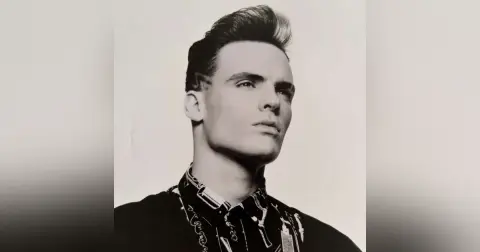
I don't have his mother on tape, so I just have the scribbled things from his mother and other people. And of course, I think you would not want me to lose this, which is this beautiful promo image of Vanilla Ice from 1990. How would you describe his look?
David Browne
Looking like Matt Dillon's lost brother or something. I'm remembering that sculpted hair. Yeah. That really kind of captures, yeah, part of his appeal that we talked about, that he was like this good looking guy, and that really helped him.
Michael Small
How about the original press release from SPK Records?
David Browne
My God.
Michael Small
I hold on to things. And then of course last of all I have articles about him from different rap magazines. I have a box where I put things that I processed on the podcast and I could just take this, it's not that thick and put it into the processed box.
David Browne
Yeah, I would say so.
Michael Small
I've so enjoyed all your things you had to say, but the fact that you're encouraging me to keep my stuff makes me even happier. The last big question for you is after hearing the tapes, did it in any way change your thoughts about Vanilla Ice?
David Browne
Well, I think it expanded my knowledge a little bit more of his background. He clearly had a love of music, and hip hop culture early in his life meant something to him. And you know, it's interesting to hear him talk about that. He wasn't faking it. And I think he had some chops as a rapper. Wouldn't call him the greatest of all time, but he had that. And so hearing him talk about that, you know, made me think he was well intended early in his career.
Michael Small
Well, okay. So that's our final word for Vanilla Ice, well intended early in his career. I thank you so much for being here. Listeners, go right now to substack.com and search for David's page called DBrief. That's the letter D, followed by the word brief. And then subscribe so you can keep up with all his insights about pop music. And go right now to bookshop.org and buy Talkin' Greenwich Village.
David Browne
Go to my website, www.david-browne.com for more information on those books and some of my articles.
Michael Small
Oka. David-Browne.com. I had two last quotes in mind for ending this episode. In one he was honest with me, in the other he was not. Here is the dishonest one.
[Interview excerpt begins]
Michael Small
I want to give you a chance if there's anything you feel like, ooh, I wanted to say this or you're worried about this or that.
Vanilla Ice (01:08:11.754)
There isn't anything now, you got the whole truth out of me.
[Interview excerpt ends]
Michael Small (01:08:14.094)
I definitely did not get the whole truth out of him. and here is the honest one.
[Interview excerpt begins]
Vanilla Ice (01:08:19.69)
As far as people really knowing me, nobody really knows me but two people.
Michael Small (01:08:22.798)
Who are those people?
Vanilla Ice (01:08:25.852)
Hahaha
[Interview excerpt ends]
Michael Small (01:08:27.616)
Yep. Wasn't gonna answer me. Okay. That's it for now. You can find links to many relevant videos about Vanilla Ice in the show notes for this episode on our website at throwitoutpodcast.com. That's throwitoutpodcast.com. And if you enjoyed this episode, please post a review wherever you get podcasts. It really, really helps. And thank you again, David.
David Browne
Thanks, Michael. It's great being here.
[Theme song begins]
I Couldn't Throw It Out theme song
Performed by Don Rauf, Boots Kamp and Jen AYehs
Written by Don Rauf and Michael Small
Produced and arranged by Boots Kamp
Look up that stairway
To my big attic
Am I a hoarder
Or am I a fanatic?
Decades of stories
Memories stacked
There is a redolence
Of some irrelevant facts
Well, I couldn't throw it out
I had to scream and shout
It all seems so unjust
But still I know I must
Before I turn to dust
I've got to throw it out
Before I turn to dust
I've got to throw it out
Well I couldn't throw it out
Oh, I couldn't throw it out
I'll sort through my possessions
In these painful sessions
I guess this is what it's about
The poems, cards and papers
The moldy musty vapors
I just gotta sort it out
Well I couldn't throw it out
Well I couldn't throw it out
Oh, I couldn't throw it out
I couldn't throw it out
[Theme song ends]
END TRANSCRIPT

Music journalist
David Browne is a contributing writer at Rolling Stone and the author of eight books, the latest being Talkin' Greenwich Village: The Heady Rise and Slow Fall of America’s Bohemian Music Capital; his other books include biographies of the Grateful Dead, Sonic Youth, Jeff Buckley and Crosby, Stills, Nash & Young. He also writes the music-themed Substack "The DBrief" More info at: david-browne.com.


